
Real film. Verified.
Motion picture film cells, authenticated by Crown, sealed in a Crown slab, and published on the Crown Database.
Film that ran through a projector has lived a life. We don’t pretend to grade it — we prove what it is. Here’s what that means, what we check, and how to send yours in.
Why we authenticate film instead of grading it
A card is graded because it left the factory perfect and the question is how close it still is. Film was never perfect. It was made to be used.
What a film print has been through
Every cell we handle was cut from a real release print — the reels a theater actually ran. That print went through projectors, sometimes hundreds of times. It was spliced, cleaned with solvent for storage, wound and rewound.
Fine lines down the frame, a warm shift in the base, a cue mark in the corner: that’s the print’s history. It is not damage, and it is not something to score.
So we answer the question that matters
A condition grade on film would tell you nothing you could use. What a collector actually needs to know is one thing: is this a genuine piece of the real print?
That is what Crown certifies. Every cell that carries our seal has been examined, its physical traits recorded, and its record published where anyone can check it.
What we check
Every cell is photographed on a light panel the moment it arrives. The authentication read comes from that photo, and both are published on the certificate — so anyone can check our work against the picture.
1
2
3
4
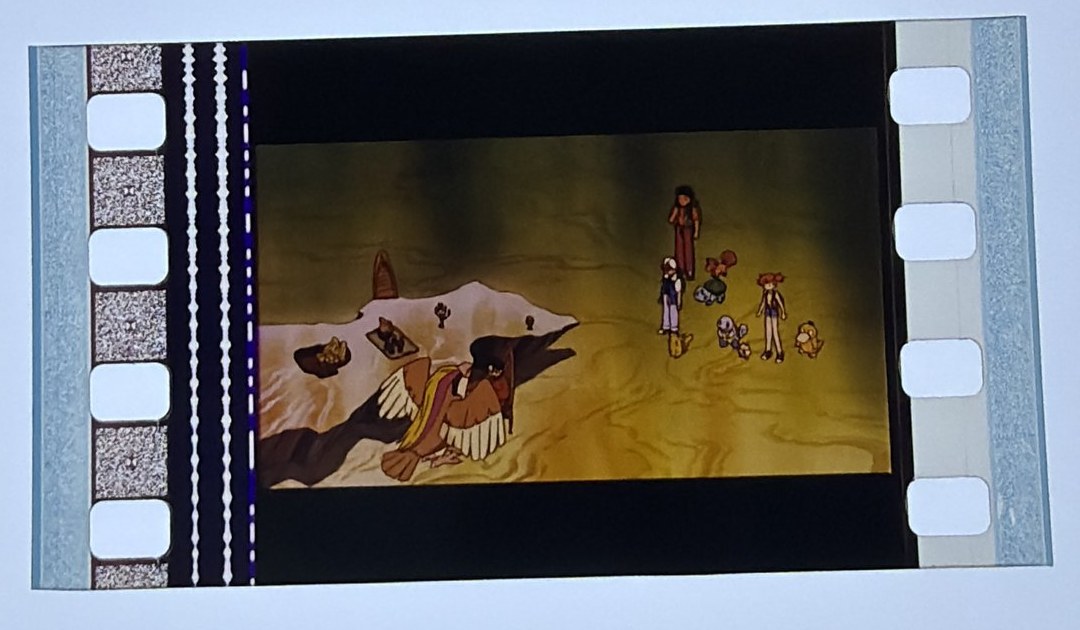
A Crown-authenticated cell from Pokémon: The First Movie (1999). The digital blocks at 2 fit a 1999 release print exactly — that kind of cross-check is the whole job.
Gauge & frames
The film width, read from how the perforations sit — 35mm, 16mm or 70mm — and how many frames the strip holds.
Perforations
Count per frame, which edges, and whether they are evenly spaced and cleanly punched. Copies on plastic sheet rarely get this right.
Soundtrack
What runs beside the picture: an optical track, Dolby Digital blocks between the holes, a DTS timecode line, or nothing at all.
Edge print
The stock maker’s markings along the edge — SAFETY FILM, manufacturer names, key numbers — quoted as read.
Base & colour
The tint of the clear base and the state of the dye image: neutral, warm, red-shifted or faded, and whether that fits the print’s age.
Projection history
Lines, scratches, cue marks and splices — recorded as evidence the print was actually run, never as a mark against it.
Picture
Positive image, not a negative. Frames that run consecutively as one shot. A scene that belongs to the film on the record.
Era check
Does everything above fit a release print of that film in that year? A digital soundtrack on a 1984 title would be a problem. We say so.
Observations, not measurements. A photograph has no scale in it, so the certificate never quotes millimetres we didn’t measure. If a feature isn’t visible in the capture, the certificate says exactly that.
What you get
The same treatment as every card we grade — sealed, serialized, and on the public record.
A sealed Crown slab
Your cell in a Crown holder with the Crown Cinema label: title, year, format, scene, and its own nine-digit Crown serial.
A public certificate
A permanent page on the Crown Database with the slab photo, the original intake capture, the authentication findings, and written film notes.
Crown Cinematic Score
Films in the Crown vault are scored once for their significance under the Crown Cinematic Standard. Where a film has been scored, its CCS prints on every cell’s certificate.
Searchable by anyone
Type the serial into the Crown Database and the record comes up. No account, no fee — a buyer can confirm your cell in ten seconds.
How to submit film
Same wizard as cards. Film just needs to know it’s film.
Start a submission and pick Film Cells
Or Both, if cards are coming in the same box. The choice sits at the top of the list.
One row per cell
Card Name → the movie and the scene, like Top Gun – Maverick in the tower. Set / Series → format and frame count, like 35mm, 3 frames. Year → the film’s release year.
Pack and ship
Each cell in a clear sleeve, sandwiched between two pieces of rigid card so nothing bends. Cards go in the same package as usual.
We do the rest
Photograph, identify, authenticate, seal, publish. Then it ships back to you with its record already live.
Questions
Can you grade my film cell instead?
No, and we’d rather explain why than sell you a number. A grade needs a factory-fresh baseline. Projected film has none. Authentication is the honest product.
Which formats do you take?
35mm is most of what we see. 16mm and 70mm are welcome too. Single frames and multi-frame strips both work — tell us the frame count in the row.
My cell has lines and marks. Is that a problem?
No. That is what a print looks like after a theatrical run. We record it under projection history on the certificate, and it never counts against the cell.
What does it cost?
Film is priced per cell in the submission wizard. You see the live total before you pay, the same as cards.